

Cracking the Code
Dr. Mary Lauren Benton pairs curiosity with computing to discover meaningful connections in genetic research and the classroom
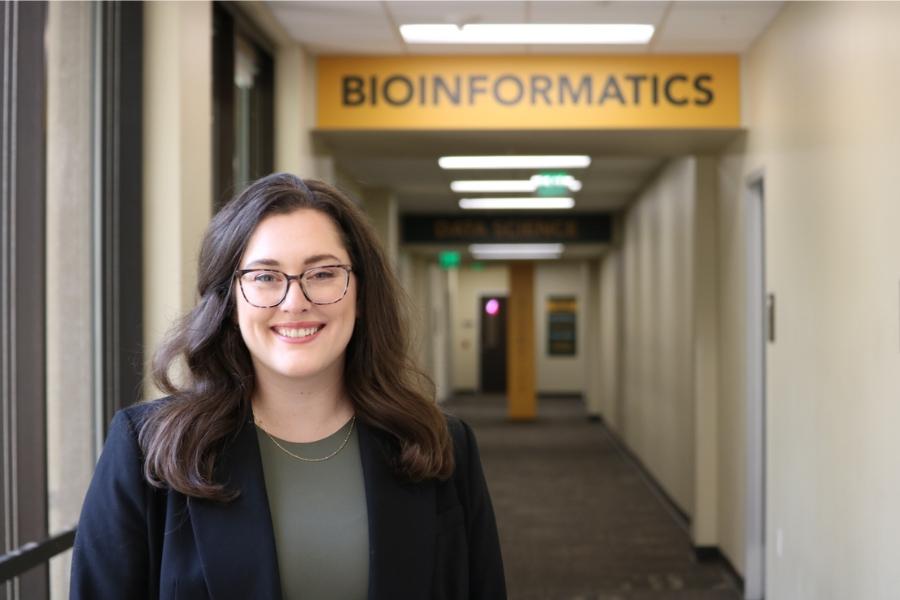
As a child, Mary Lauren Benton, B.S.I. ’15, Ph.D., was drawn to puzzles of all kinds: the more challenging, the better. Riddles, logic, crosswords and jigsaw puzzles all held the same allure, the opportunity to problem-solve. When dumping out a 1,000-piece jigsaw puzzle featuring an image of hundreds of postage stamps that all looked similar, Benton remembers thinking, “Oh, this will be hard,” with a feeling of delighted anticipation. Perhaps it’s this mindset — finding excitement instead of dread in difficult challenges — that has allowed Benton to flourish in the world of bioinformatics, even if she originally wandered into the field by accident.
Stumbling onto the right path
“As a Baylor undergraduate, my intention was to pursue medical school, but I mistakenly attended an orientation for bioinformatics. The connection to biology and medicine with the bonus of learning to program and work with data intrigued me,” Benton recalled. “I knew I wanted a career that felt like it mattered in people’s lives. Bioinformatics is all about solving puzzles in order to understand how things and people work, which leads to lots of practical discoveries that can make life better for real people.”
After graduating from Baylor’s School of Engineering and Computer Science with a degree in bioinformatics, Benton went on to earn her Ph.D. in biomedical informatics from Vanderbilt University before returning to her alma mater to teach and conduct research.
These days, as an assistant professor in bioinformatics, Benton’s puzzles look like sequences of numbers representing the makeup of DNA and related genetic coding. She uses computer science methodologies to interpret how DNA sequences alter genome function and impact human disease risk. In other words, her research queries seek to understand what makes us sick and how to prevent it.
“If a human genome sequence was a text file, it would be about 3 billion characters long. And we’re looking for these really tight patterns that might only be around 150 characters — a needle in a haystack,” Benton explained. “If we want to know, for instance, how a change in one or two letters among sequences of billions of characters from thousands of people can lead to a disease, we can’t do that by hand. That’s where the power of computing comes in.”
Data science as a team sport
Much of Benton’s work is made possible by collaboration. She and her colleagues analyze vast amounts of data — those human genome “text files” — procured from Baylor labs as well as national and international consortia, then share their models and predictions with other geneticists through scientific publications and related conferences so they can apply the findings in their own laboratories.
“We don’t work directly with patients, but everything we do is part of a much bigger team effort,” Benton said. “Geneticists, neuroscientists, medical researchers — we’re all building on each other’s progress. No one can do this alone.”
That spirit of teamwork, she noted, is what transforms isolated data points into discoveries that can ultimately change lives — each contribution serving as one piece of a much larger puzzle.
Shaping students into scientists
Perhaps the most unexpected players in this landscape are Benton’s own students. Involving undergraduates in her work, in fact, is the reason she chose to establish her career at Baylor.
“Baylor prioritizes undergrad engagement in a way many big research universities don’t, and that has always mattered deeply to me,” she shared.
To this end, Benton’s classes are structured less like lectures and more like puzzle-solving workshops. She builds a framework, then invites students to bring in their own questions and interests. Over the years, her students have tackled projects on everything from the genetics of shark migration to frogs that can survive freezing and thawing, to specific questions related to diseases like diabetes, cancer and Alzheimer’s.
“Every class feels like its own puzzle to solve,” Benton said. “I’m always figuring out how to connect with students from different majors, backgrounds and motivations. I learn something new every semester because I give them the freedom to pick real-life issues that matter to them.”
National spotlight: Where innovation meets impact
Her innovative approach to teaching has earned Benton national recognition. This year, she was named a KEEN Rising Star, one of only three faculty in the country to receive the honor in 2025. Given by the Kern Entrepreneurial Engineering Network, supported by the Kern Family Foundation, the award highlights early-career faculty who excel at equipping undergraduates with an “entrepreneurial mindset” — a way of thinking that prioritizes a spirit of inquiry, creativity and real-world impact.
“What’s different about KEEN’s entrepreneurial focus is that it’s not about business — it’s about curiosity, making connections and creating value,” Benton explained. “That resonates with me. When students tackle a real-world problem where nobody knows the answer — not even their professor — that builds resilience and motivation in a way a textbook never could.”
The recognition also provides resources for Benton to expand her work in integrating research into classrooms.
“The goal is not just to innovate for my own students, but to create frameworks that other faculty can use, too,” she said.
Pursuing the next piece
For Benton, both research and teaching are ongoing explorations — equations without final answers.
“If we do it right, we don’t actually get to the end,” she reflected. “We just come to the place where we can now ask the next question — something one step bigger than what we just attempted. That’s what keeps the work exciting.”
This outlook may be Benton’s most valuable puzzle piece in the bigger picture of how she serves others through her field: seeing the journey, not the destination — the right questions, not a solitary answer — as the real breakthrough. And then passing that gift of an ever-hungry mind on to the next generation.