

Point-of-Need Innovation
Game-Changing Materials Research Advancing Solutions
Fighter jets, Army vehicles, Navy vessels, spacecraft — they all share a commonality that is being addressed in Baylor’s School of Engineering and Computer Science: when these pieces of equipment break down, the people who rely on them need them returned to safe operational standards as quickly as possible.
By the very nature of their use, various challenges stand in the way: their locations in the field are often inaccessible, the materials they need are complex and the availability of replacement parts relies on an unpredictable supply chain dependent on external factors.
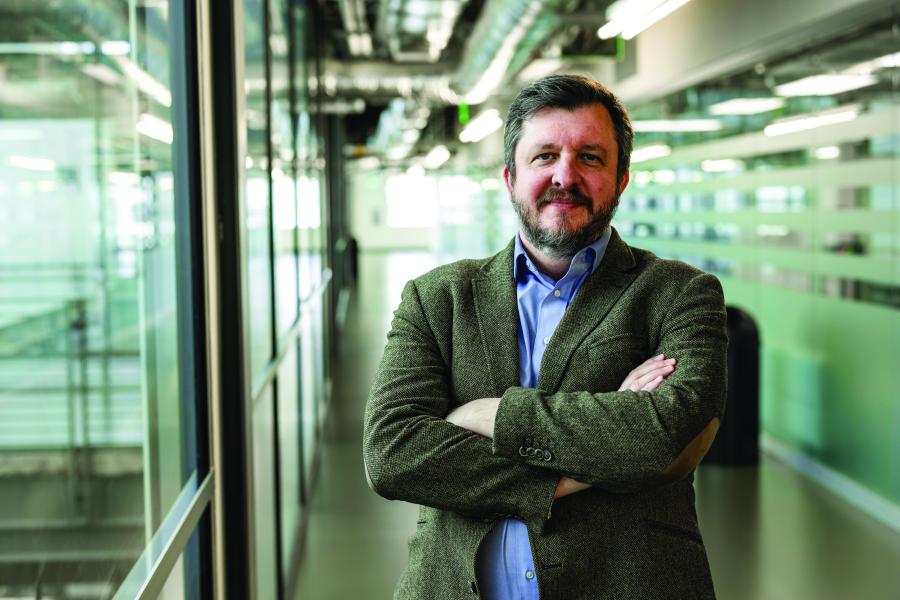
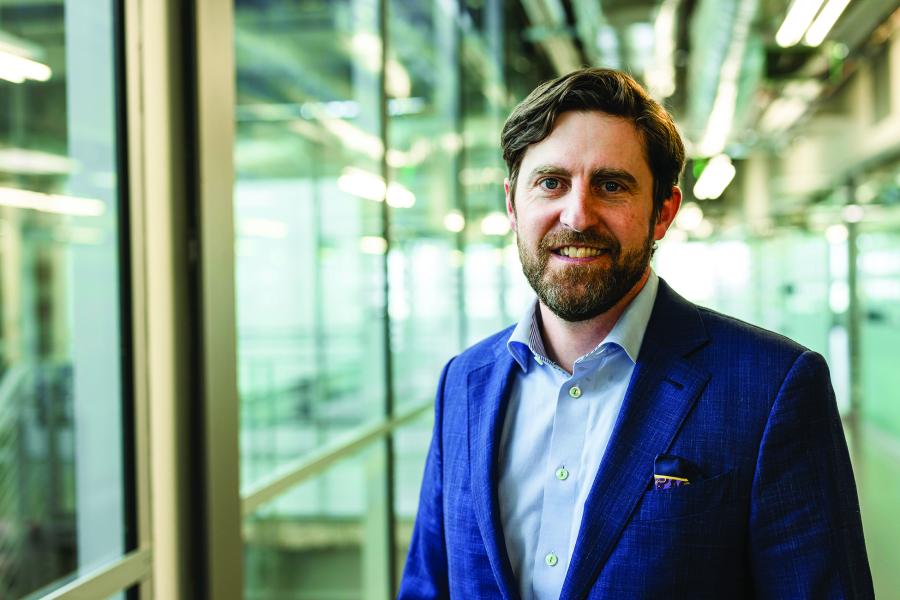
These challenges motivate the work of Mechanical Engineering Professors Brian Jordon, Ph.D. and Paul Allison, Ph.D. As collaborators at the University of Alabama, they built a reputation as elite materials science researchers, with millions in external funding and partners like NASA, the Department of Energy and the Department of Defense (including the Army, Air Force, Marines and Navy). At Baylor, they found a place where they could advance that work even further.
ENRICHING MATERIALS SCIENCE AND ENGINEERING EXPERTISE
Baylor University was looking for faculty members just like Jordon and Allison to build on a strong and growing expertise in materials science and engineering.
The duo has developed an enviable research portfolio through the advancement of cutting-edge approaches in additive and advanced manufacturing, including leadership work in a cutting-edge process called Friction Stir Additive Manufacturing (FSAM).
More simply, their research focuses on methods to move the entire process of repairs beyond traditional supply chains and enable organizations to use waste products to repair materials on-site. At the micro level, these advances would enable organizations like the Army to get vehicles back into the field faster by repairing them at the location of use. The large-scale benefit would be an entirely new process that is cheaper, faster and more sustainable for all involved. Collaborators like the Department of Defense and private industry came calling, and Jordon and Allison developed a reputation as leaders in the field.
Baylor likewise came calling. Key to Baylor’s growth — would be the formation of new endowed chair positions and recruitment of elite faculty. To that end, Baylor donors Ken, B.A. ’69, Ph.D. ’96, and Celia Carlile funded the formation of The Kenneth and Celia Carlile Endowed Chair in Materials Science to address that need, and Jordon was an obvious choice for the University to contact. When he became aware of the position, he was intrigued by the idea of working at a Christian institution, but had questions.
“You wonder if there’s going to be a support system in place, and a willingness to invest in a research area that is not, for the lack of a better word, cheap,” Jordon said. “With every response from Baylor, I was floored. I walked away saying, ‘These guys are serious about this.’ And since then, Baylor has over-delivered on every promise.”
Jordon chose to make that move, but he didn’t come alone. Paul Allison, a longtime collaborator well before their time at Alabama, was recruited to lead the inaugural interdisciplinary Point-of-Need Innovations (PONI) Center at Baylor, while also serving as a full professor of mechanical engineering. It was a major move for all involved, and their 10 graduate students had to make a difficult choice to stay at Alabama or follow them to Baylor. Eight of them made the move to Waco along with their mentors.
POINT-OF-NEED INNOVATIONS
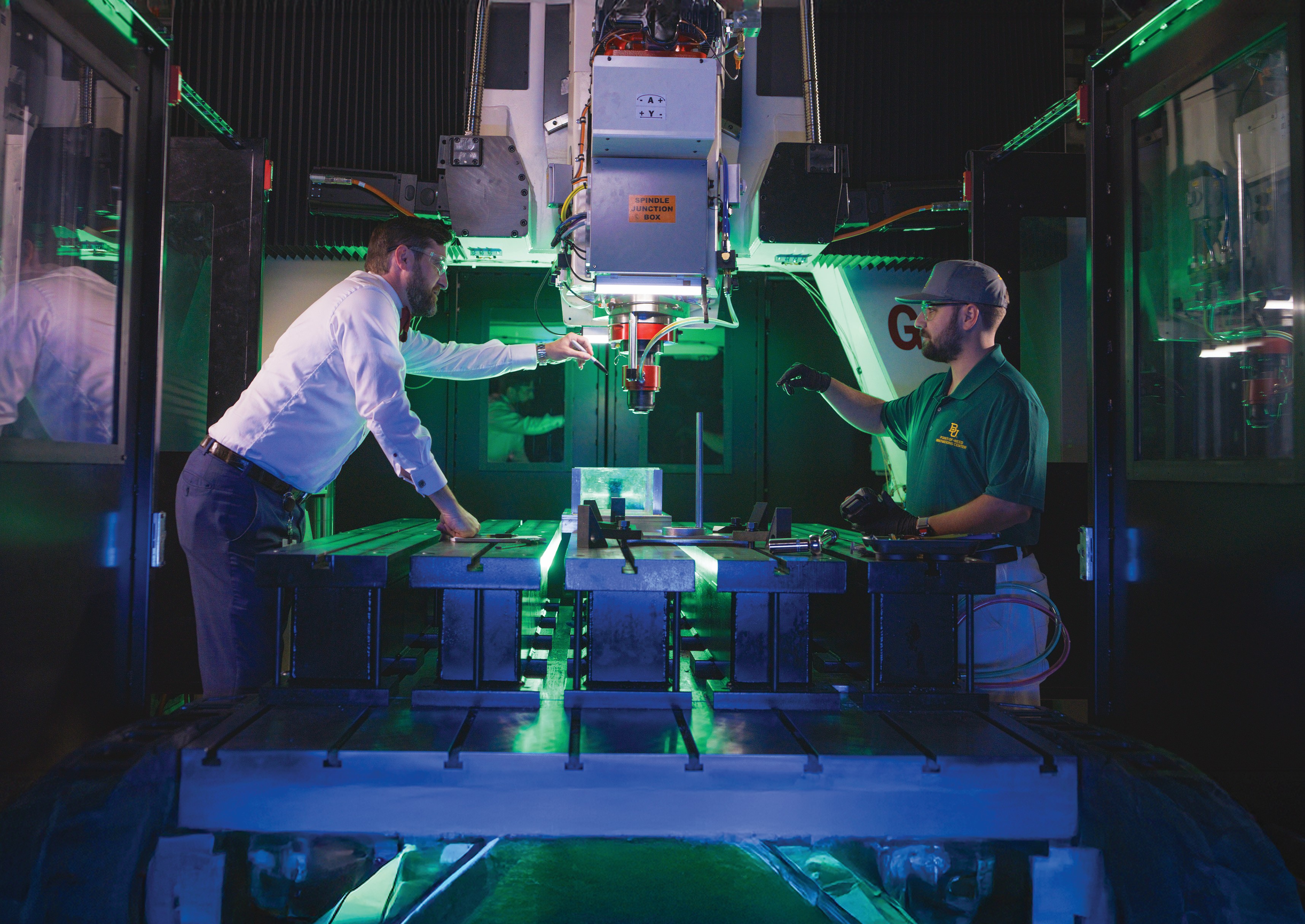
On a typical day, the Point-of-Need Innovations Center is alive with activity as students, staff and faculty 3D print and test the behavior of materials like steel, titanium, aluminum and more. Students test for impact, blast and fatigue behavior while also developing new material and process models of the types of products to repair or replace the materials needed by their clients at the location of use. Above the state-of-the-art machinery that populate the floor, flags bearing the logos of every branch of the U.S. military and more are positioned as constant reminders of who the work is for.
Two years after the move to Baylor, the PONI Center is fully operational in the Baylor Research and Innovation Collaborative (BRIC). Jordon and Allison continue to manage over $20 million worth of funded research projects. Baylor faculty members from the School of Engineering and Computer Science, College of Arts & Sciences, Hankamer School of Business and School of Education serve as associate directors or affiliated faculty, giving PONI a truly multi-disciplinary roster to provide expertise to that work.
Currently, they’re in the first year of a $15 million partnership with the Department of Defense, University of New Hampshire and Solvus Global to advance Friction Stir Additive Manufacturing (FSAM), a nascent technology that the U.S. Army hopes to mature. It’s a project emblematic of the work they do.
“There is a long lead time for many items the Army needs for aircraft and ground vehicles, like gearboxes for rotorcraft or replacement structural components for ground vehicles,” Allison said. “The parts can take a long time to get because you have to cast, forge, and finish machine them, and if anything goes wrong, you have to go back and recast, and that can reset the clock for a year. That’s not ideal when you’re trying to support military or humanitarian operations.”
FSAM is PONI’s response to that challenge. To envision FSAM in action, PONI students make a comparison to cooking with butter.
“The FSAM process mechanics are similar to softening a stick of butter so it spreads easier. Spreading butter on bread straight from the refrigerator is nearly impossible. However, with warm butter the spreading is smooth. The butter is not melted to a liquid, just softened,” Trevor Hickok, a second-year Ph.D. student explains. “Through friction, we generate heat to spread the metal and create these metal layers.”
Allison adds further, “Our metal deposition for FSAM takes place in a solid malleable state where it is not molten, and this offers advantages in terms of how strong the defect-free bonded metal layers ends up being when high strength is required.”
Their work is geared toward the development of a low-power, nimble process that utilizes locally available raw materials instead of expensive materials. All the while, the process still must deliver the same properties as the more time-consuming approaches — quicker, cheaper and more sustainable. As the technology matures, manufacturers could integrate these advances into the development process within the next five years.
A PASSION FOR MENTORSHIP
FSAM is just one example. Still, other students are at work on a $3 million National Science Foundation research project with a goal of utilizing floating debris in space to create new materials that could someday aid human habitation in space.
Although exciting, these projects aren’t the biggest motivator for Jordon and Allison’s work. Mentorship is what most drives them, and the decisions by most of their Alabama graduate students to follow them to Baylor attests to that devotion.
The Point-of-Need Innovations Center according to Allison, “produces highly skilled and valuable people solving difficult scientific and engineering challenges that can transition from the laboratory to having immediate impacts for humanitarian, medical or military requirements at the location-of-use, globally or even in space.
“A lot of our students have gone on to be hired by the Army, Navy, Department of Energy, NASA, Boeing, Lockheed-Martin, Kratos and more. That’s what we produce — people that are experts in this technology. That’s probably one of the things I think we’re most proud of.”