

Photonic Breakthrough
Engineering Research Named Top 5 By National Science Foundation
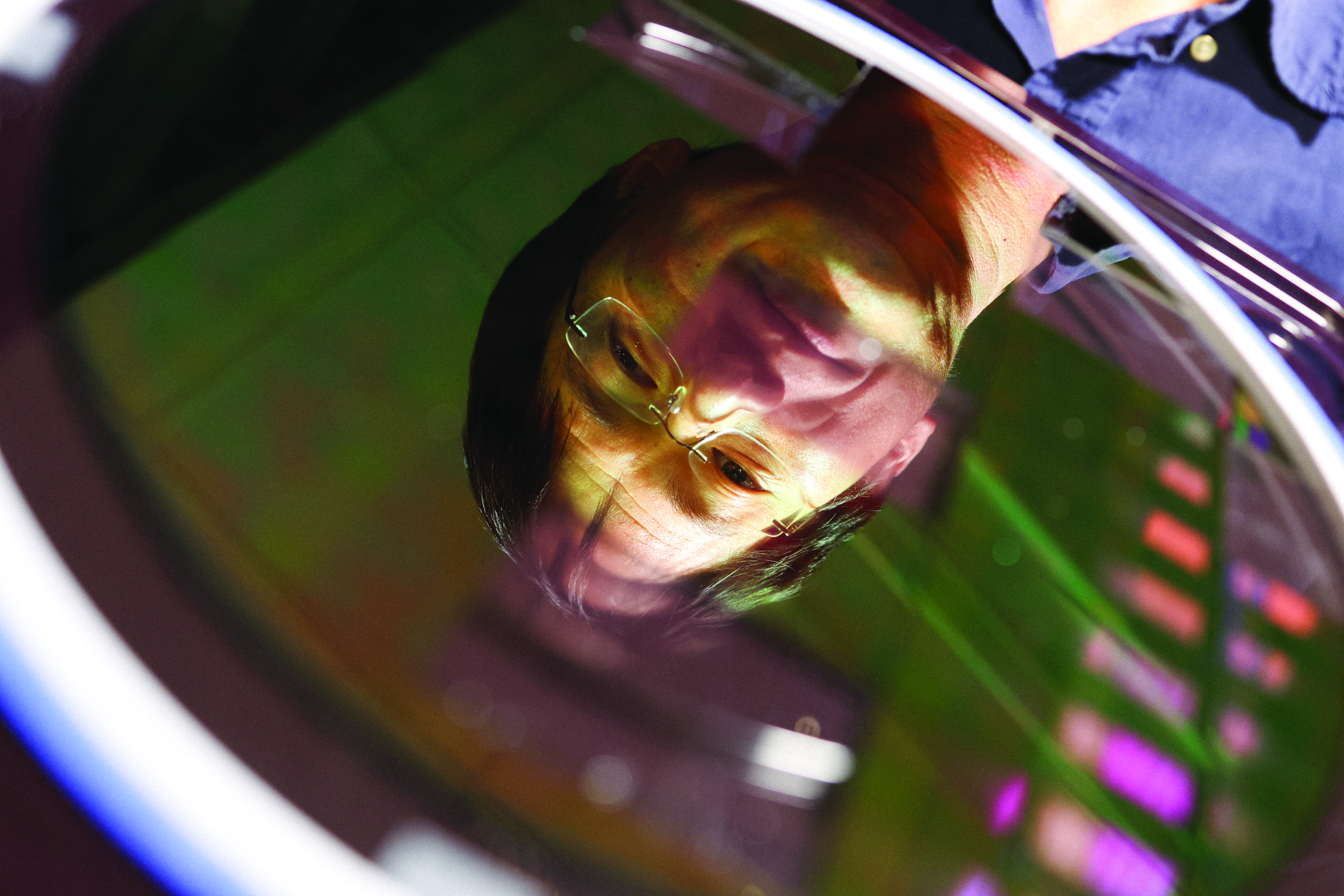
Breathing the chilly air in Guadalupe Mountains National Park during winter break, Alan Wang, Ph.D., and his family were steadily hiking up to the highest point in Texas when he received the news: the National Science Foundation (NSF) had deemed his research project to be one of its Top 5 Research Stories of 2023.
“I know we are doing great work, but it was really a big surprise to me to be recognized at this level,” says Wang, the Mearse Endowed Chair in Biological and Biomedical Engineering at Baylor University. “That news definitely made us pick up our pace.”
Society enjoys the benefits provided by supercomputers and data centers, but we pay a big price for the enormous amount of energy required, notes Wang, who also is a professor in the department of electrical and computer engineering at Baylor.
His team’s work on the photonic integrated circuits (PICs) at the Nano-Optics & Advanced Health Sensing (NOAHS) Lab can significantly reduce energy consumption.
“We must find ways to make energy usage for AI sustainable,” Wang says.
One important approach is to replace parts of the electronic circuits with PICs, because photonics can provide higher bandwidth and transmit signals over a longer distance with lower energy consumption.
“The photonic chip we developed enables the connection between optical fiber and electronic devices, because if you want to send information over the optical fiber, first you must convert the electronic signals into optical signals,” Wang explains. “My team works on those kinds of photonic circuits.”
An important factor in keeping the PICs working is to keep the temperature stable, which is normally achieved by a power-hungry thermal heater. The work reported by NSF involves a different approach, with Wang’s team replacing low-efficiency thermal heaters with electrostatic tuning, allowing for voltage control without a current, meaning there’s literally no energy consumption.
Wang’s team built a MOS capacitor (a typical structure for a transistor) on a silicon photonic platform to obtain the desired electrostatic tuning.
The NSF honor is just one of many this year for Wang and his team. Among the highlights:
• Wanng was elected as a Fellow of SPIE, or Society of Photo-Optical Instrumentation Engineers, which is a leading society in optics and photonics.
• Wei-Che Hsu, a doctoral student who began under Wang’s guidance while both at Oregon State, has been doing research for the last two years as a visiting student at Baylor. He won first place in the Division of Laser Science (DLS) Poster Competition at CLEO 2024, which is the top conference in photonics.
• The team’s work was published in Nature Communications, a top journal in science and engineering.
COLLABORATION, COMMERCIALIZATION WITH INTEL
The article in Nature Communications covered a continuation of the work highlighted by NSF but on a more significant device of the PICs system.
“There’s a more critical device we call the electro-optical modulator, which converts electronic signals into optical signals. This device consumes almost half of the energy of the entire PICs chip, so improving the energy efficiency here is significant,” Wang says.
In collaboration with Intel Corp., Wang’s team developed a high-mobility conducting oxide material to significantly improve the energy efficiency of the modulator.
One of this year’s significant grants for Wang is the Partnerships for Innovation Project award from National Science Foundation, which is particularly important because it is designed to accelerate commercialization. For new technologies to become commercially viable, they should be compatible with existing fabrication technology. Working directly with Intel, the largest photonics chip vendor, helps to streamline and accelerate the lab-to-market process.
“Collaborating with Intel, and especially with their production team in this project, is critical,” Wang says. “The silicon industry wants to have the performance improvement but with minimum modification to their existing processes.”
THE MOVE TO BAYLOR (AND WHAT’S NEXT)
Wang spent a decade in Texas before living in Oregon for 11 years. Now in his third year back in Texas at Baylor, he and his family are enjoying the Christian fellowship Baylor and Waco offer.
“The church life here is a true blessing, for example, fellowships and home meetings are things I find joyful. For me, being part of a supportive faith community is as important as having a productive career.”
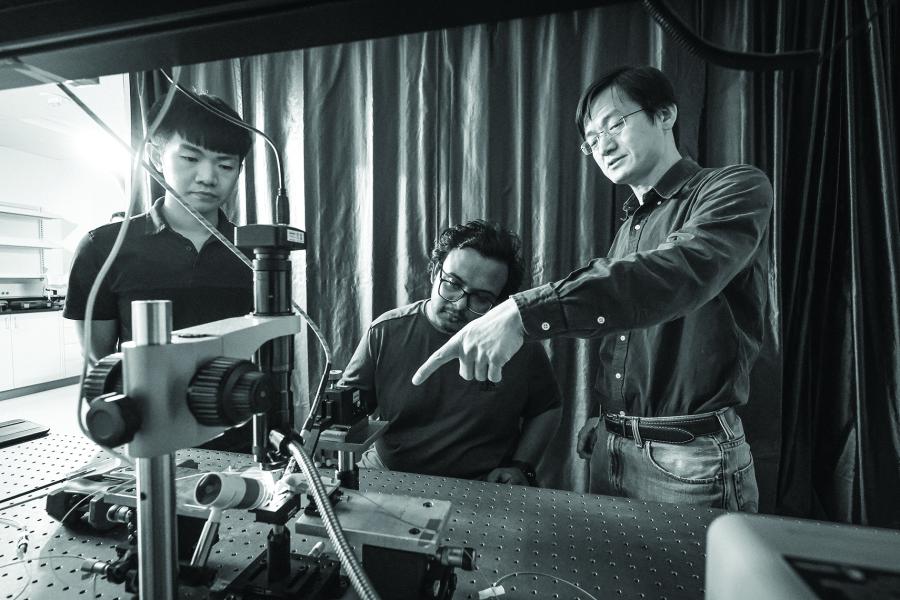
Wang’s NOAHS lab is fully established inside the 330,000 sq. ft. Baylor Research and Innovation Collaborative (BRIC). While his team appreciates the recent expansion of the Micro and Nanofabrication Clean Room at the BRIC, Wang looks forward to the addition of more fabrication equipment so that his graduate students don’t have to travel to other facilities to complete some of their work.
As research at Baylor is clearly in a stage of rapid growth, opportunities abound.
“Baylor is a rising star in research,” Wang said. “There will be a lot of opportunities to work at Baylor, both for faculty and for graduate students from the U.S. and from other countries.”
With its location in Central Texas, which is booming economically (and especially) in semiconductors and information technology, Baylor is a place where faculty and students can reach high career peaks and enjoy life in a supportive community.